
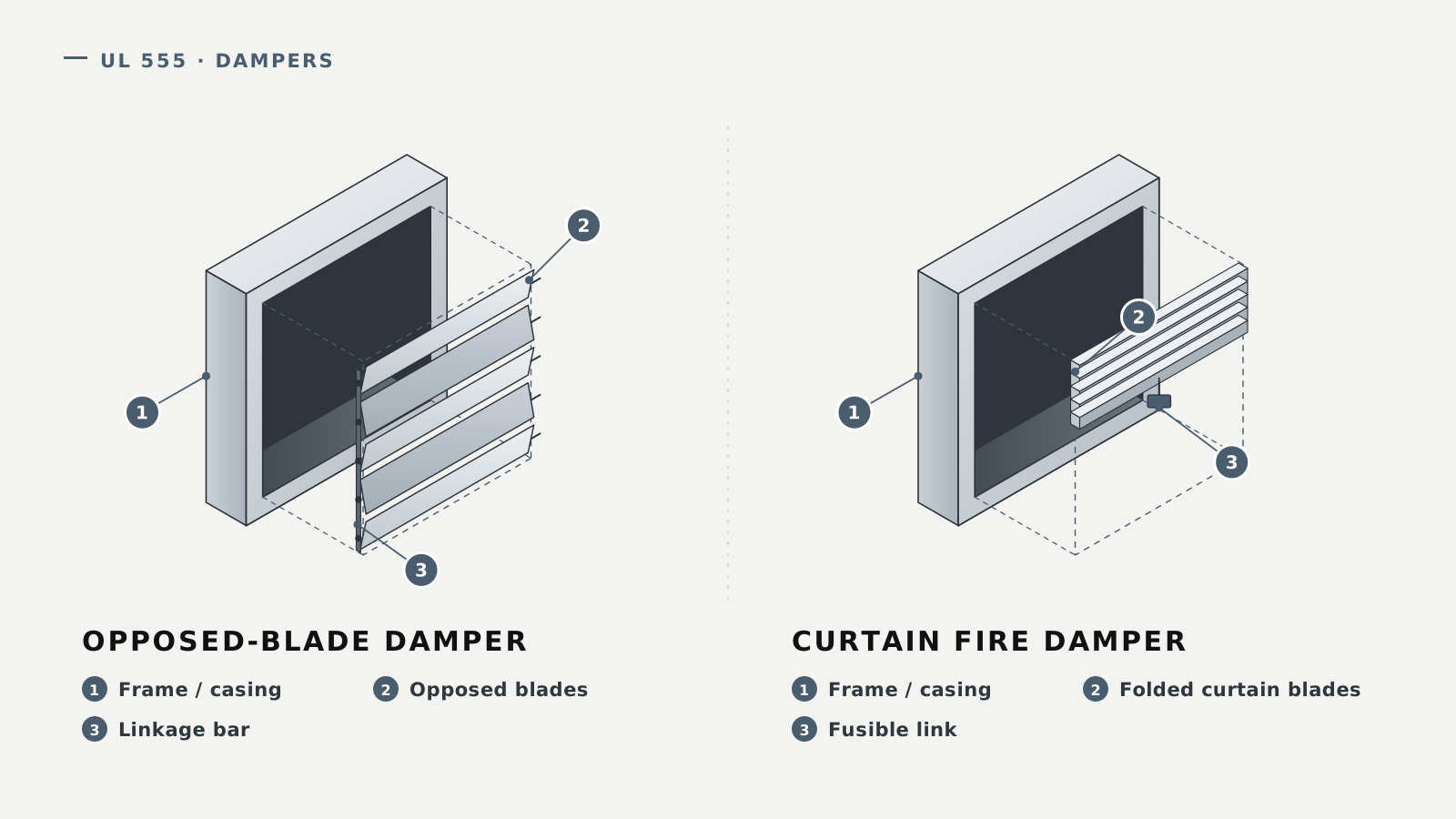
Damper selection is a critical part of any HVAC design. The wrong damper can fail a fire safety inspection, delay your handover, or worse — fail during an emergency. This guide covers the three main damper types and the UL 555 compliance requirements that govern them.
The three main damper types
Volume Control Damper (VCD)
A Volume Control Damper regulates airflow within a duct system. It does not provide fire protection — its sole function is to balance or shut off air distribution to specific zones. VCDs are typically made of galvanized steel and are manually or motor-operated.
Use VCDs in: office buildings for zone control, plant rooms, general ventilation systems, and anywhere precise airflow balancing is needed.
Motorized Volume Control Damper
The motorized VCD adds actuator control, allowing remote or automated operation via BMS (Building Management Systems). These are used where airflow needs to be adjusted dynamically based on occupancy, temperature, or schedule.
Fire Damper — UL 555
Fire dampers are designed to prevent the spread of fire through ductwork. They are required wherever ductwork penetrates a fire-rated wall or floor assembly. These are the most regulated damper type and must be UL 555 listed; motorized fire dampers are UL 555 classified too.
UL 555 compliance checklist
- Fire rating: minimum 1.5-hour or 3-hour depending on wall rating
- Must be UL 555 listed (label visible on unit)
- Fusible link temperature: 74 °C (165 °F) standard; 100 °C (212 °F) optional
- Must include access door for inspection
- Installation must follow NFPA 90A and QCS 2024 Section 22
- Quarterly testing required per NFPA 80
Which damper do you need?
| Application | Recommended Damper |
|---|---|
| Fire-rated wall penetration | Fire Damper (UL 555) |
| Zone air balancing | Volume Control Damper (VCD) |
| BMS-controlled airflow | Motorized VCD with actuator |
| Stairwells / corridors | Motorized Fire Damper |