
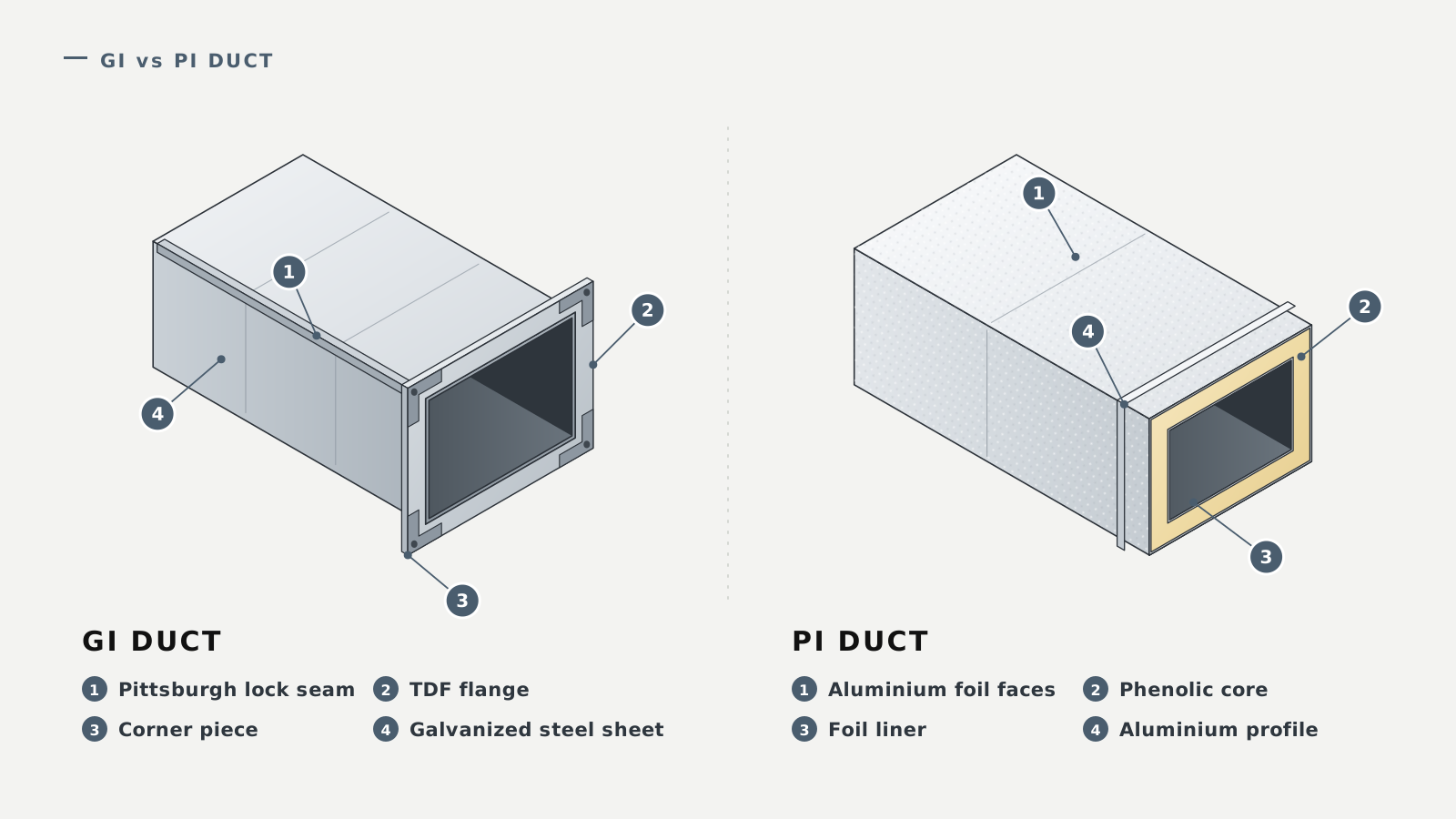
Choosing between galvanized iron (GI) duct and pre-insulated (PI) duct affects installation time, the insulation scope, the submittal documents and the final installed cost. Tawreed Trading & Contracting fabricates both at its factory in Birkat Al Awamer, so this guide compares them on documented data only: the GI duct datasheet, the WellWall phenolic duct board documentation and the PIR panel specifications published on our product pages.
What is GI duct?
GI duct is fabricated from galvanized steel sheet. It is the most widely used duct type in commercial and industrial HVAC systems and is built to withstand high static pressures. Our GI duct is made from galvanized steel with a minimum zinc coating of 275 g/m² to BS EN 10346, in sheet thicknesses from 0.4 mm up to 3 mm (GI duct datasheet).
Fabrication follows SMACNA and QCS 2024 Section 22. Rectangular duct is made with TDF flanges and Pittsburgh lock or snap-lock seams, and circular and oval profiles are also available. The GI duct datasheet includes the SMACNA gauge-versus-duct-size and joint tables for the 500 Pa, 750 Pa and 1000 Pa pressure classes, together with a SMACNA conformity letter. For example, at 750 Pa a rectangular duct with a 601–1200 mm longer side uses 0.80 mm sheet, and a duct with a 1050–1200 mm longer side is joined with a 30 mm flange (source: GI duct datasheet, SMACNA and joint tables; all three tables are in our SMACNA pressure class guide).
GI duct carries supply, return and exhaust air, and it can be made in the factory or fabricated on site to the project BOQ. It is not insulated when it is made: thermal insulation, typically glass wool or PIR, is added on site after the duct is installed, as a separate step with its own material and labour.
Where a project needs more than standard galvanized duct, the same GI duct range includes fire-rated duct and stainless steel duct for corrosive environments, kitchen exhaust, laboratories and clean rooms.
What is PI duct?
Pre-insulated (PI) duct combines the duct and its insulation in one panel: a rigid foam core with aluminium foil facings on both sides. The panels are cut and assembled into duct in our factory in Qatar, so the duct arrives on site already insulated. We fabricate PI duct with two cores.
Phenolic (WellWall)
Our phenolic pre-insulated duct is fabricated from WellWall phenolic duct board, made by Jiangyin WellWall Insulation Material Co., Ltd. (China). The manufacturer’s datasheet gives a panel thermal conductivity of 0.021 W/(m·K) (ASTM C518) and a density of 65 ± 5 kg/m³. The board is documented to UL 181 as a Class 1 air duct (UL file MH63347), with a rated air velocity of 25 m/s and a rated pressure of +1000 Pa / −750 Pa. The UL 181 listing covers above-ground indoor use only, where the duct air temperature does not exceed 121 °C.
PIR
Our PIR pre-insulated duct uses a polyisocyanurate rigid foam core with aluminium foil facing inside and out. Its product page lists a thermal conductivity of 0.023 W/(m·K), operating pressure up to 2000 Pa (Class B), air velocity up to 25 m/s, panel thicknesses of 20, 25, 30 and 40 mm, and an operating temperature range of −40 °C to +100 °C.
PI duct suits air-conditioning systems where thermal performance and condensation control are critical, which is why it is used in hot and humid climates. Joints, corners and openings are finished with dedicated PI duct accessories: profiles, flanges, PIR adhesive and aluminium foil tape.
GI duct vs PI duct: side by side
| Factor | GI duct | PI duct |
|---|---|---|
| Installation speed | Moderate: insulation is added on site as a separate step | Fast: duct and insulation in one panel |
| Pressure rating | SMACNA gauge and joint tables for 500 / 750 / 1000 Pa (GI duct datasheet) | Phenolic: +1000 Pa / −750 Pa (UL 181 listing); PIR: up to 2000 Pa (Class B) |
| Fire rating | Fire-rated duct is available as a separate product | Phenolic duct board: Class 1 air duct to UL 181 (UL file MH63347) |
| Thermal performance | Depends on the insulation added on site | Phenolic panel λ 0.021 W/(m·K); PIR λ 0.023 W/(m·K) |
| Typical use | High static pressure, custom sizes, exposed runs; supply, return and exhaust air | Indoor conditioned spaces, fan coil connections, ceiling voids, fast installation |
The PI duct values come from the WellWall phenolic documentation and the PIR product page. The GI pressure classes are the ones covered by the SMACNA tables in our GI duct datasheet.
What drives the installed cost
We do not publish a price comparison, because the installed cost depends on the project. These are the factors that decide it:
Material
GI duct depends on sheet thickness and the amount of steel; PI duct depends on the core (phenolic or PIR) and the panel thickness.
Insulation
GI duct needs insulation as a separate material and a separate labour step on site. PI duct arrives insulated.
Installation time
PI duct is assembled from factory-cut panels with the insulation already in place. GI duct is installed first and insulated afterwards.
Weight and supports
PI duct is light, which matters on light ceilings. GI duct and its insulation are heavier, and the hangers and supports must suit that weight.
Site waste
Insulating GI duct on site adds a second material with its own off-cuts and packaging. PI duct panels are cut to size in the factory.
Send your BOQ and we will quote both options, GI duct with the insulation you specify and phenolic or PIR duct, within 4 business hours. Request a quote.
Where each one fits
GI duct is the usual choice for
- systems with high static pressure, and custom sizes or shapes;
- exposed ceilings where the galvanized duct stays visible;
- supply, return and exhaust air systems;
- special applications through fire-rated or stainless steel duct.
PI duct is the better choice for
- indoor conditioned spaces;
- fan coil unit connections and ceiling-void runs;
- light ceilings and fast-track work, where light weight and fast installation matter;
- supply and return runs within the documented pressure ratings above.
The two systems can be combined in one building. On Burj Damac Seaviews, for example, we supplied both GI duct and PI-Duct, together with the air outlets.
Compliance in Qatar
In Qatar, ductwork is governed by QCS 2024 Section 22 (Air Conditioning, Refrigeration and Ventilation), Part 06 (Ductwork and Air-Side Equipment). Our GI duct is fabricated to SMACNA and QCS 2024 Section 22. Part 06 specifies galvanized steel sheet for ductwork unless the project documentation specifies otherwise, so PI duct is used where the project specification calls for it.
For PI duct, the WellWall phenolic duct QCS 2024 compliance datasheet gives a clause-by-clause statement against Section 22 Part 06, with the relevant extracts, ready for the submittal. For what Section 22 Part 06 covers and how our GI duct, PI duct and dampers comply, read our QCS 2024 HVAC compliance guide. Fire dampers are a separate submittal item for both duct types; our damper guide explains the UL 555 requirements. Compliance statements and Civil Defence registration documents are available on request.
Datasheets
- GI duct datasheet: rectangular duct, TDF / TDC flanges and seams, fittings, the SMACNA conformity letter and the gauge and joint tables. Download it from the GI duct page.
- WellWall phenolic pre-insulated duct: the product datasheet, test reports and the QCS 2024 compliance statement, on the phenolic pre-insulated duct page.
- Pre-insulated duct installation and maintenance manual: also on the phenolic pre-insulated duct page.
Need a document that is not published yet? Request it through the submittal page.