
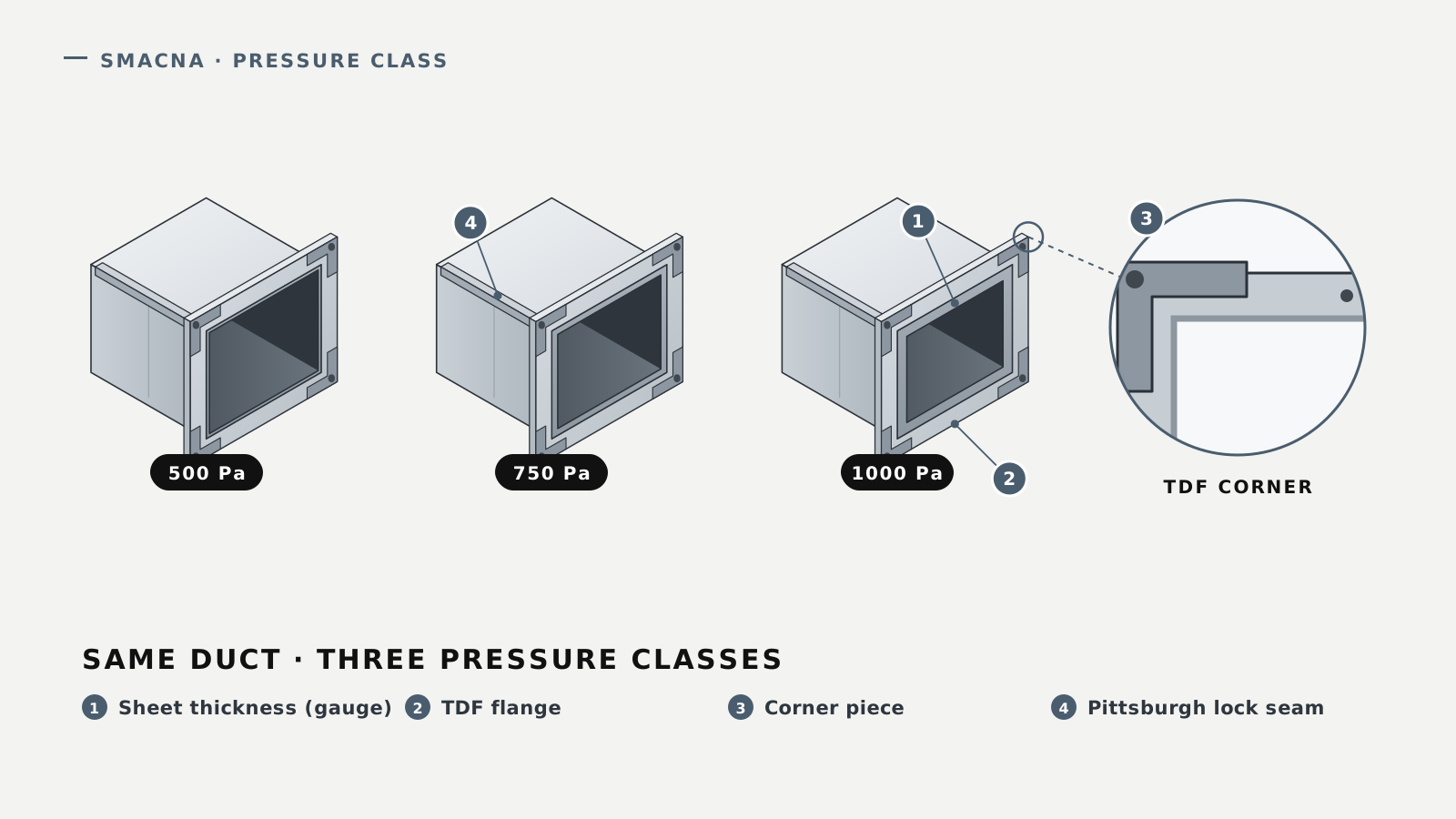
Every rectangular duct on a drawing has two numbers that decide how it is built: its size and its pressure class. Together they set the sheet thickness and the joints. This guide explains the pressure classes we fabricate and how to read them against the SMACNA tables.
What a pressure class is
A pressure class groups ductwork by the static pressure it must withstand. For each class, the SMACNA tables give the sheet gauge and the joints for each duct size.
QCS 2024 uses the same idea. Section 22, Part 06 defines low-pressure ductwork as ductwork with mean velocities below 10 m/s and static pressures of 500 Pa or less (clause 6.2.4), and medium-pressure ductwork as ductwork subject to pressures up to 1000 Pa (clause 6.2.5). Clause 6.2.2 adds that fabrication and hanging methods follow the ASHRAE Guide and Data Book and/or the applicable SMACNA manuals. Our QCS 2024 guide covers these clauses in full.
The three classes we fabricate
| Pressure class | Range in QCS 2024 Part 06 | Where the gauge comes from |
|---|---|---|
| 500 Pa | Low-pressure ductwork, 500 Pa or less (6.2.4) | SMACNA gauge and joint table for 500 Pa |
| 750 Pa | Within the medium-pressure range, up to 1000 Pa (6.2.5) | SMACNA gauge and joint table for 750 Pa |
| 1000 Pa | Medium-pressure ductwork, up to 1000 Pa (6.2.5) | SMACNA gauge and joint table for 1000 Pa |
All three tables, reproduced below, are in section 05 of the GI duct datasheet, "Gauge vs. duct size and joint tables (500 / 750 / 1000 Pa)", which you can download from the GI duct product page. The same datasheet includes a SMACNA conformity letter, and its sections 02 and 03 cover rectangular duct with TDF/TDC flanges and seams, and fittings and branch connections.
How the gauge follows size and class
Our GI duct datasheet covers sheet from 0.4 mm up to 3 mm. For rectangular duct, the thickness is read from the SMACNA tables rather than chosen freely:
Find the pressure class
Take the class of the system from the design: 500, 750 or 1000 Pa.
Find the duct size
Find the row for your duct size in the table for that class.
Read the gauge and joints
The table gives the sheet gauge and the joint for that size. A larger duct, or the same duct in a higher class, can need a heavier gauge.
Sheet thickness vs duct size (SMACNA, rectangular duct)
| Longer side (mm) | 500 Pa (≤ 2" w.g.) | Longer side (mm) | 750 Pa (≤ 3" w.g.) | Longer side (mm) | 1000 Pa (≤ 4" w.g.) |
|---|---|---|---|---|---|
| 0–750 | 0.60 mm | 0–600 | 0.60 mm | 0–500 | 0.60 mm |
| 751–1350 | 0.80 mm | 601–1200 | 0.80 mm | 501–900 | 0.80 mm |
| 1351–2100 | 1.00 mm | 1250–2950 | 1.00 mm | 901–1050 | 1.00 mm |
| 2101 & above | 1.20 mm | 3000 & above | 1.20 mm | 1051–1350 | 1.20 mm |
| 1351 & above | 1.5 mm |
Transverse joints (identical for 500, 750 and 1000 Pa)
| Longer side (mm) | Transverse joint |
|---|---|
| 0–500 | Opposite sides flat hemmed S cleat and drive cleat |
| 550–1000 | 20 mm flange – snap on sides, corners and clips |
| 1050–1200 | 30 mm flange – snap on sides, corners and clips |
| 1250–1600 | 30 mm flange + reinforcement stiffener 30×30×3 mm angle at 610 mm centres |
| 1650–2500 | 30 mm flange + stiffener 40×40×4 mm angle at 610 mm centres |
| 2501 & above | 40 mm flange + stiffener 50×50×4 mm angle at 610 mm centres |
Send us your duct sizes and pressure class and we will apply the tables for you.
TDF flanges and Pittsburgh lock seams
The pressure class also decides the joints. Our GI duct is made with TDF flanges and Pittsburgh lock seams, with snap-lock seams as another seam option. Our flanges, corner pieces and cleats follow SMACNA joint classifications and are compatible with all standard GI duct gauges and sizes.
TDC/TDF flanges
Roll-formed galvanized steel flanges in 25, 30, 35 and 40 mm widths, 1.0 mm thick, with bolt holes pre-punched at 150 mm centres.
Corner pieces
Reinforced galvanized steel corner pieces for TDC flanges, used at each corner of a rectangular duct joint.
Pittsburgh lock seam
Our GI duct is made with flanged, Pittsburgh lock and snap-lock seam options.
Drive cleats
S-drive and standing drive cleats in galvanized steel, compatible with all standard GI duct gauges and sizes.
What to put on your BOQ
To get the right gauge and joints in the quotation, give us:
- The pressure class of each duct system: 500, 750 or 1000 Pa.
- Duct sizes in mm and the profile: rectangular, circular or oval.
- Quantities with units (m, pcs, m² or sets), and notes such as a required sheet thickness.
- Whether you need supply only or supply and installation.
- Any project requirement beyond SMACNA, such as QCS 2024 compliance documents.
Our galvanized duct is fabricated to SMACNA and QCS 2024 Section 22, for supply, return and exhaust air, and standard GI duct orders are usually ready within 2 working days of order confirmation. Send your BOQ through the quote form for a formal quotation within 4 business hours, and request the datasheet and compliance documents through the submittal page.